Follow Me On Twitter

Saturday, March 30, 2013

Pushed Over The edge By Benefits Fear


12/6/12

to me
Hello samuel i do hope your well.....i was at my uncles funeral yesturday he hung him self last monday...he was disabled and was told he was fit for work. This is what upsets me the most because am not well and going through this my self i cant help my own friends an family .i got a letter saying iv got to got to court with my appeal now.like i havnt waited long enought. I really hate these ppl for what they are doing


10:22 PM (15 minutes ago)

to me
hi samuel...... i hope your well and had a good xmas,new year,an now easter,,,,sorry i havent bin in touch,,,,with having two court cases to prepare for an not being able to pay bill ect,i have been so depressed pluss with my uncle killing him self the day before my birthday..........i just though you would like an update on peter 


Pushed over the edge by benefits fear

A WOMAN whose disabled partner was found hanged is warning of the “devastating’’ effects of impending changes to disability benefits.
Christine Graham is speaking out after attending the inquest of 49-year-old Peter Hodgson, which returned a verdict of suicide last Friday.
Mr Hodgson was found dead at his Cleator Moor home just a day after he received a text message telling him to attend the Jobcentre. He had previously sent Christine, his partner of 13 years, a text saying: “I give up.’’
Now, only days before the Disability Living Allowance is replaced by a new scheme, Christine continues to be concerned about those who face upheaval due to the changes.
“Peter was vulnerable,’’ she said. “The text scared him so much. He had been depressed for years but he could keep that under control. It was the text which pushed him over.
“I want people to realise the effect of these changes on people’s lives. These changes are terrifying to vulnerable people and their concerns need to be listened to.
“It can have a devastating effect on people’s lives. As someone said after Peter died, he won’t be the first person to die because of this, and he won’t be the last.’’
Mr Hodgson had been unable to work after he suffered a brain haemorrhage and a stroke and had his leg fused following a football injury. He had previously worked as a lifeguard and at Brannan’s Thermometers.
Christine said: “You only had to look at Peter to realise he couldn’t work.’’
Mr Hodgson also wore a calliper and couldn’t grip with his hand. He had been worried that if he didn’t take some sort of work, his benefits would be stopped.
Last July, Mr Hodgson had been called into Whitehaven Jobcentre to see whether he would be suitable for volunteer work. He subsequently received a text on the afternoon of November 26. The message didn’t state a date but a subsequent letter was sent days after Mr Hodgson’s death with an appointment for December 17.
It was this text, Christine said, which had pushed her partner over the edge.
Four months after his death, Christine is trying to move on with her life. “I’m managing and I know nothing will bring Peter back. But I still believe if he hadn’t received the text he would still be here now. He had been perfectly fine until then.’’
After The Whitehaven News ran Peter’s story in December, there was an overwhelming response from readers.
From April 8, Disability Living Allowance, or DLA – the benefit which helps many pay for care and mobility costs – is being scrapped and more than two million disabled people will lose the support they rely on. The replacement – Personal Independence Payment (PIP) – is designed to cut £2.24billion annually from the welfare budget by 2015-16. The number eligible for the new award will be smaller and the assessment criteria are narrower.
According to the Government, the changes will see around 500,000 people lose their benefit.
Speaking this week about the new disability reforms, the Paralympian and campaigner Tanni Grey-Thompson, said: “People are either shown as amazing Paralympians who are competing for their country, who are incredible individuals, or benefit scroungers. What I don’t want to see is disabled people ghettoised and locked away like it was when I was young. The danger is if we just keep knocking disabled people back then we’ll turn the clock back 30 years.”

Friday, March 29, 2013

Is the International Criminal Court (ICC) striving to discourage the filing of austerity complaints under article 7(k)?

Mrs. Fatou Bensouda, ICC Prosecutor
Information and Evidence Unit
Office of the Prosecutor
International Criminal Court
Post Office Box 19519
2500 CM The Hague
The Netherlands


Dear Ms. Bensouda,

I am a 56-year-old Disability Studies specialist from Montreal, Canada who has been reporting frequently, for the past sixteen months, to United Nations officials on the crisis for the United Kingdom's sick and disabled. Austerity measures, consisting of  draconian welfare reforms and "sham" means-testing (Atos Healthcare U.K. and the Department for Work and Pensions) are ostensibly to blame for their plight—with disability hate crime and inflammatory media attacks factored into this mix. 

According to a October 2, 2012 letter that I received from the OTP Information Desk, the International Criminal Court "may only address the crimes of genocide, crimes against humanity, and war crimes as defined by Articles 6 to 8 of the Rome Statute."

Frankly, the OTP Information Desk response, omitting article 7, is puzzling. As you are well aware, the Rome Statute is the document under which the ICC was established. Article 7, which covers crimes against humanity, states: “For the purpose of this Statute, “crime against humanity” means any of the following acts when committed as part of a widespread or systematic attack directed against any civilian population, with knowledge of the attack:

“(k) Inhumane acts … intentionally causing great suffering, or serious injury to body or to mental or physical health.”

Article 7 (k) is a perfect description of what the DWP and its ministers are trying to achieve. Is the ICC striving to discourage the filing of austerity complaints?

I would like to bring the following to your attention:

A German human rights lawyer has brought charges to the International Criminal Court (ICC): austerity enforced on Greece is a crime against humanity.
 Human rights lawyer Sarah Luzia Hassel-Reusing submitted charges to the ICC at the Hague. She accused the heads of government and international financial institutions responsible for Greece’s austerity of crimes against humanity. These were submitted in late November. Using the Rome Statute article 7, Hassel-Reusing’s indictment related to the destruction of Greek healthcare and incidents of starvation. Those accused are
  • Christine Lagarde (Director of the International Monetary Fund, IMF),
  • Jose Manuel Barroso (President of the EU Commission),
  • Herman van Rompuy (President of the European Council),
  • Dr. Angela Merkel (German Chancellor),
Hassel-Reusing’s submission asserts how stipulations of austerity, set by the Troika, are causing a humanitarian crisis. Greeks are denied access to vital medicine and healthcare, suffer a massive reduction in health service provision, whilst under conditions of mass unemployment. The human rights lawyer’s charges rely on statistics and media reports, showing that even before the 2009 imposition of austerity – many Greeks lived below the poverty line. Thus she presented that by reducing the rights, welfare, employment and state provisions: austerity has made a bad situation far graver.
In legal terms, a crime against humanity is judged if someone purposefully attacks a population or acts knowing this will happen. This is why she is is focusing on the removal of health provision, and the impact Troika’s measures are having against the Greek’s access to food. Both healthcare and the universal right to food are protected by UN articles. The charges assert that the policy of financial stability is a smokescreen, deceiving the public about the real human disaster that these measures are causing.
Hassel-Reusing is arguing that Greece is being used as an experiment, to see how far austerity can be implemented to attack public services and increase privatisation. The motive of those implementing the austerity she argues, is to create a transfer of wealth by squeezing the poor. The submission asserts how this even risks the disintegration of the European Union. The charges broadens too, to  include financial powers, both political and international bankers, especially Goldman Sachs, Bilderberg, and Deutsche Bank.
(See https://docs.google.com/viewer?a=v&pid=sites&srcid=ZGVmYXVsdGRvbWFpbnxidWVyZ2VycmVjaHRlbWVuc2NoZW5yZWNodGV8Z3g6NTBmYzQ5ZGUxMjhlMmYzNA)

Furthermore, there is growing recognition by the Office of the High Commissioner for Human Rights (OHCHR) that

Austerity measures may violate human rights
Half a decade has passed since the sub-prime mortgage crisis in the United States developed into a global financial crisis. In response, many countries undertook large-scale “bailouts” of virtually bankrupt banks. With the bailouts and other knock-on effects of the financial crisis, public deficits have risen sharply in many countries.
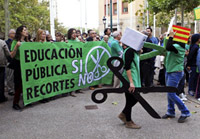
Students in a rally in Spain © EPA/JAVIER CEBOLLADAGovernments, notably in Europe, have responded to mounting deficits with “austerity” measures - making drastic reductions to public expenditure.
Austerity has entailed rapid decreases in standards of living as cuts have been made to public services and social protection, while unemployment levels have risen dramatically.
Addressing the United Nations General Assembly in New York on 23 October 2012, the Chairperson of the Committee on Economic, Social and Cultural Rights, Ariranga Govindasamy Pillay, noted that although States face tough decisions when dealing with rising public deficits, austerity measures are potentially violations of the legal obligations of States Parties to the International Covenant on Economic, Social and Cultural Rights.
“All States Parties should avoid at all times taking decisions which lead to the denial or infringement of economic, social and cultural rights,” Pillay said, citing an open letter to States Parties from the Committee earlier this year. The letter elaborated the Committee’s position on austerity measures.
By ratifying the Covenant, States Parties have a legally binding obligation to progressively improve, without retrogression, universal access to goods and services such as healthcare, education, housing and social security and to ensure just and favourable conditions of work, without discrimination, in accordance with established international standards.
These rights must be achieved by using the maximum of available resources. However, Pillay pointed out that austerity measures are also a disincentive to economic growth and thereby hamper progressive realization of economic and social rights.
The Committee had pointed out that social insecurity and political instability, as seen in parts of Europe today, were also potential effects of the denial or infringement of economic, social and cultural rights. The poor, women, children, persons with disabilities, older persons, people with HIV/AIDS, indigenous peoples, ethnic minorities, migrants and refugees were particularly at risk, the Committee had noted.
In a recent statement, the United Nations High Commissioner for Human Rights, Navi Pillay, expressed concern over rising social tensions inflamed by the effects of the economic crises in Greece and Spain and the broader adverse impacts of austerity measures on the most vulnerable.
Several United Nations human rights experts have recently highlighted how austerity measures are incongruent with economic, social and cultural human rights and called for banking sector reforms and human rights-based approaches out of financial and economic crises. (2 November 2012; see http://www.ohchr.org/EN/NewsEvents/Pages/AusterityMeasures.aspx)

 and recognition, from the prestigious British medical journal "The Lancet", that European austerity is costing lives:


SPIEGEL ONLINE

03/27/2013 05:08 PM

Shredded Social Safety Net

European Austerity Costing Lives

As the euro crisis wears on, the tough austerity measures implemented in ailing member states are resulting in serious health issues, a study revealed on Wednesday. Mental illness, suicide rates and epidemics are on the rise, while access to care has dwindled.
The rigid austerity measures brought on by the euro crisis are having catastrophic effects on the health of people in stricken countries, health experts reported on Wednesday.
Not only have the fiscal austerity policies failed to improve the economic situation in these countries, but they have also put a serious strain on their health care systems, according to an analysis of European health by medical journal The Lancet. Major cuts to public spending and health services have brought on drastic deterioration in the overall health of residents, the journal reported, citing the outbreak of epidemics and a spike in suicides.
In addition to crippling public health care budgets, the deep austerity measures implemented since the economic crisis began in 2008 have increased unemployment and lowered incomes, causing depression and prompting sick people to wait longer before seeking help or medication, the study found.
The countries most affected by this have been Portugal, Spain and Greece, the latter of which saw outbreaks of both malaria and HIV after programs for mosquito spraying and needle exchanges for intravenous drug users were axed. There were also outbreaks of West Nile virus and dengue fever.
"Austerity measures haven't solved the economic problems and they have also created big health problems," Martin McKee, a professor of European Public Health at the London School of Hygiene and Tropical Medicine, who led the research, told news agency AP.
It will take years to understand the health consequences of the euro crisis and the policies it has prompted, but some effects are already clear, the study said. Not only has there been an increase of mental disorders in Greece and Spain, but the number of suicides for those younger than 65 has increased in the EU since 2007 -- "reversing a steady decrease." In Greece, the Ministry of Health reported a 40 percent jump in suicides between January and May 2011, compared to the same period the year before.
Officials Accused of Ignoring Problems
While budget cuts have restricted health care access with increased costs for patients in these three nations, Greece has also seen shortages in medication, hospital staff and supplies, according to the study, commissioned in part by the European Observatory on Health Systems and Policies, a partner of the World Health Organization.
The study authors also accuse European officials of failing to address these issues, writing that "public health experts have remained largely silent during this crisis."
"There is a clear problem of denial of the health effects of the crisis, even though they are very apparent," lead researcher McKee told Reuters, comparing their response to the "obfuscation" of the tobacco industry. "The European Commission has a treaty obligation to look at the health effect of all of its policies but has not produced any impact assessment on the health effects of the austerity measures imposed by the troika."
The troika, made up of the European Commission, European Central Bank and International Monetary Fund, has been in charge of bailing out ailing European economies -- most recently in Cyprus -- and of policing the implementation of the austerity measures the study blames for deteriorating health in these countries.
But it doesn't have to be that way, the study suggests, citing Iceland as a success story. Though the country was one of the first to be hit by the financial crisis, it "rejected the economic orthodoxy that advocated austerity … and invested in its people who, evidence suggests, have had very few adverse health consequences."
kla -- with wire reports


In closing, I believe that I am owed an explanation as to why your office will not prosecute austerity cases under article 7(k).

I look forward to receiving your response at the earliest possible convenience.

Samuel Miller


--
Samuel Miller
http://independent.academia.edu/SamuelMiller
http://socialwelfareunion.org/archives/2501
http://you.38degrees.org.uk/petitions/letter-to-the-icc-at-the-hague-re-mistreatment-of-the-disabled-and-sick
http://mikesivier.wordpress.com//?s=Samuel+Miller&search=Go
http://www.youtube.com/watch?v=VnHBfW0_u5A&feature=youtu.be
E-Mail: disabilityinliterature@gmail.com
Blog: Hephaestus: Disability Studies
http://illnessandcivilization.blogspot.com/
Blog: My Disability Studies Blackboard
http://mydisabilitystudiesblackboard.blogspot.com/
Twitter: http://twitter.com/#!/Hephaestus7

Sunday, March 24, 2013

The Jobcentre Sanctions Scandal In Britain: With Limited Access To Food Banks, Destitution Is A High Risk For Hundreds of Thousands

Currently briefing senior UN officials (including Ms.Magdalena SepĂșlveda Carmona, Special Rapporteur on extreme poverty and human rights, and Mr. Olivier De Schutter, Special Rapporteur on the right to food) regarding the destitution of UK benefit claimants who have been sanctioned by Jobcentres and stripped of any income for weeks or months if they are deemed to be not trying hard enough to find work.

A question for my Twitter followers: Sanctioned benefit claimants have limited access to food banks and are at high risk of destitution. A couple of the articles below mention the right to an independent appeal, but there is no mention of the timescale (i.e. delay) between the appeal being made and the appeal decision rendered. Does anyone know? Should I write the DWP?


A total of 680,000 sanctions were handed out in the 10 months up to October 2012, already more than in the whole of 2011, according an analysis of figures from the DWP—so this has evolved into a serious and considerably urgent matter.

References: Food Poverty: UN Special Rapporteur Finds Austerity, Food Banks And Working Poor In UK 'Extremely Worrying' (http://www.huffingtonpost.co.uk/2013/02/19/food-poverty-un-special-rapporteur-olivier-de-schutter-banks-austerity_n_2714969.html)

Magdalena SepĂșlveda: 'Austerity is devastating for the world's poorest'(http://www.guardian.co.uk/society/2013/feb/26/magdalena-sepulveda-austerity-devastating-worlds-poorest?INTCMP=SRCH)

Jobcentre was set targets for benefit sanctions
(http://www.guardian.co.uk/society/2013/mar/21/jobcentre-set-targets-benefit-sanctions)

The jobseeker's story: 'I'm not proud to say I've gone begging'
(http://www.guardian.co.uk/society/2013/mar/22/jobseekers-story-benefit-sanctions)

Jobcentre sanctions: 'Your money is stopped, you go into freefall' - video
(http://www.guardian.co.uk/politics/video/2013/mar/22/jobcentre-sanctions-money-stopped-video)

Mum's fears after benefits stopped
(http://www.clydebankpost.co.uk/news/roundup/articles/2013/03/22/450852-mums-fears-after-benefits-stopped-/#.UU8H5_Kh6oM.twitter)

My letter to Labour MPs Michael Meacher, Tom Greatrex, and Julie Hilling: (http://www.twitlonger.com/show/n_1rjcsol)

Atos scandal: Benefits bosses admit over half of people ruled fit to work ended up destitute (http://www.dailyrecord.co.uk/news/scottish-news/atos-scandal-benefits-bosses-admit-1344278#.UTEpHYKiPYM.facebook)


--
Samuel Miller
http://independent.academia.edu/SamuelMiller
http://socialwelfareunion.org/archives/2501
http://you.38degrees.org.uk/petitions/letter-to-the-icc-at-the-hague-re-mistreatment-of-the-disabled-and-sick
http://mikesivier.wordpress.com//?s=Samuel+Miller&search=Go
http://www.youtube.com/watch?v=VnHBfW0_u5A&feature=youtu.be
E-Mail: disabilityinliterature@gmail.com
Blog: Hephaestus: Disability Studies
http://illnessandcivilization.blogspot.com/
Blog: My Disability Studies Blackboard
http://mydisabilitystudiesblackboard.blogspot.com/
Twitter: http://twitter.com/#!/Hephaestus7
(Montreal, Canada)

Monday, March 18, 2013

We could stop the Bedroom Tax if we Chose to. Here's how.

http://diaryofabenefitscrounger.blogspot.co.uk/2013/03/we-could-stop-bedroom-tax-if-we-chose.html

It's funny, isn't it. Every one of the policies we oppose are easily defeated.

Abolishing Disability Living Allowance, Severe Disability Premiums, the Independent Living Fund.
The Bedroom Tax, Council Tax Cuts, Slashing tax credits for disabled children.
The feared and hated Employment Support Allowance, limiting it to just one year, Workfare.
NHS "reform" press abuse, energy profiteers, loan sharks, slave wages

In just an hour or two, we could get rid of the lot.

There are 65 million of us and 650 of them. We just have to say "Erm, no thanks."

"We didn't vote for this, sorry, now off you go and think again."

It really is as easy as that. (Other countries do it all the time, we just seem to have forgotten why we fought for democracy in the first place)

So. At the end of the comment section on THIS post : http://diaryofabenefitscrounger.blogspot.co.uk/2013/03/the-human-story-behind-bedroom-tax.html
The last 4 or 5 comments (left by an "A Smith" - sorry efforts to trace unsuccessful - if this has been posted elsewhere, I hope you'll forgive me) DO appear to give an excellent blueprint for destroying the Bedroom Tax.

Effectively, (and it IS vital you read the comments A Smith left if you want to really understand why I agree, I think this would work) councils will issue a "Benefit Decision Notice (BDM)" to say that you will be affected by the Bedroom Tax. 

The letter will describe how you can appeal. 

If everyone affected reads the comments A Smith left, writes back to their council asking them to explain/reconsider within 7 days

Then appeals within one month of the BDM

The system - and local council's ability to deal with the fallout - would come grinding to a halt. It simply could not function and would cost millions more than the tax will save. 

Again, to take part, it's crucial you read all of A Smith's shared reasoning and advice here in the comments thread, at the end : http://diaryofabenefitscrounger.blogspot.co.uk/2013/03/the-human-story-behind-bedroom-tax.html

So, a quick click on the link above and 10 minutes to read the comments. 

Then, a letter, with stamp, once you get your BDM sent immediately. 

A further letter requesting an appeal (there is even a template you can use left by A Smith) SENT WITHIN ONE MONTH OF ORIGINAL BDM

That's it. All there is to it.

If all 660,000 people affected objected, then asked to go to appeal, the system would collapse.

All for the sake of a 10 minute read and 2 letters.

DWP estimate 200,000 people will lose their homes from this policy. 440,000 of those affected have disabilities.

We can accept it passively, or like the poll tax, we can say "Actually, no, I don't think so"

That's it. All there is to it.

So if you agree, share this post. Send it to friends you think might be affected. Email it. Help any vulnerable friends you have to take the simple action. The Bedroom Tax is a BIG deal on social media but do we want to moan about it or stop it? If we want to stop it, share this post and act.

The only thing allowing ALL of these policies to go forward, is our acceptance.


Aha! Thanks to the wonders of twitter, we've found the original post. It was on SPeye here http://speye.wordpress.com/2013/03/14/bedroom-tax-why-and-how-all-tenants-should-appeal-and-the-impact/ and author IS a housing advisor. 


3 comments:

  1. Tweeted it, g+ed it. I don't know anyone subject to it or I'd pass it to them direct.
    Reply
  2. I was discussing that very thing the other day...how other countries say 'No thanks' en masse. I will share this excellent post. HMSx
    Reply
  3. Government keen to silence Twitter.Pity we can't silence them like a huge public vote of no confidence.

Monday, March 11, 2013

Jean Cozens talking about psychiatric abuse

Mental Health Resistance Network
4:33 PM (2 hours ago)

to Blue, bcc: me
The link below leads to an interview with Jean Cozens. Jean was an active member of the Mental Health Resistance Network; she can be seen sitting near our banner in the picture at the top of our  Facebook page. Six weeks after recording this, on Christmas Day, 2012, Jean ended her life. 


https://www.google.co.uk/url?sa=t&rct=j&q=&esrc=s&source=web&cd=5&cad=rja&ved=0CEUQFjAE&url=http%3A%2F%2Fvideo.twicsy.com%2Fi%2FZxt6&ei=bj0-UfOhPMvA7Ab814CgCw&usg=AFQjCNHAar4qB5fPzYDzAgVJ3RFuvs0gJw&sig2=SVwxgP6AjqyNdVv2KojVMw&bvm=bv.43287494,d.d2k

Denise

Saturday, March 2, 2013

REGISTRATION NOW OPEN: Fantastic! Heroic! Disabled? "Cripping" the Comic Con

Fantastic! Heroic! Disabled? "Cripping" the Comic Con

April 11, 2013
SYRACUSE UNIVERSITY
Syracuse, NY
8:00 am to 9:30 pm

Goldstein Student Center, 201ABC (8:00am-5:45pm)
With a Reception and Special Postconference Session at the Skybarn (6:00 pm to 9:30 pm)
Syracuse University's South Campus
Syracuse, NY

This symposium provides participants with the opportunity to engage in a broad array of reflective discussions about the representations of disability that exist "beneath the surface" and explicitly within mainstream popular cultures both nationally and internationally, particularly the popular culture phenomena that are comic books, graphic novels, and manga.

Keynote Presentation:

"Death, Disability and the Superhero: The Silver Age and Beyond"
By José Alaniz, Ph.D.
Associate Professor
Department of Slavic Languages and Literatures and
the Department of Comparative Literature (adjunct) at the University of Washington-Seattle

SPECIAL POST EVENT SESSION
Disability Activism & Fandom: A roundtable strategizing on fandom as a target of/resource for activism

For more information or to register, visit:
http://crippingthecon.com
Twitter: @cripcon
Facebook: http://www.facebook.com/CrippingTheCon

Sponsors of this symposium include the SU Disability Cultural Center, the Center on Human Policy, the Disability Student Union (DSU), the Beyond Compliance Coordinating Committee (BCCC), and Disability Studies at Syracuse University.


Rachael A. Zubal-Ruggieri
Co-Chair, Fantastic!  Heroic! Disabled? "Cripping" The Comic Con" Symposium
Information Coordinator, Center on Human Policy
Syracuse University
School of Education
805 South Crouse Avenue
Syracuse, NY  13244-2280
315-443-2761 | FAX 315-443-4338
E-mail:  thechp@syr.edu<mailto:thechp@syr.edu> | razubal@syr.edu<mailto:razubal@syr.edu>
http://disabilitystudies.syr.edu<http://disabilitystudies.syr.edu/>
http://crippingthecon.com


Thursday, February 28, 2013

ENABLE NEWSLETTER February 2013

ENABLE NEWSLETTER
February 2013

The United Nations Enable Newsletter is prepared by the Secretariat for the Convention on the Rights of Persons with Disabilities (DSPD/DESA) with input from UN offices, agencies, funds and programmes, as well as from civil society organizations, including organizations of persons with disabilities. It is also available online at: www.un.org/disabilities.

In this issue:

- Status of the Convention on the Rights of Persons with Disabilities (CRPD)
- Highlights from the UN system
- Upcoming calendar of events
- Other news

STATUS OF THE CRPD

129 ratifications and 155 signatories to the CRPD
76 ratifications and 91 signatories to its Optional Protocol (OP)

- Barbados ratified the Convention on 27 February 2013
- Albania ratified the Convention on 11 February 2013

HIGHLIGHTS FROM THE UN SYSTEM

High-level Meeting on disability and development (23 September 2013)
The High-level meeting of the General Assembly on disability and development (HLMDD: http://www.un.org/hlmdd2013) is expected to take place at the level of the Heads of States on 23 September, this year. Prior to the meeting, a draft text of the outcome document will be produced by the President of the General Assembly in consultation with Member States, along with input from organizations of persons with disabilities and other relevant stakeholders, through online discussions and informal consultations. Toward this end, DESA, in partnership with UNICEF will conduct online consultations under the existing platform of the World We Want 2015 from 8-28 March. (http://www.worldwewant2015.org)

Commission for Social Development concludes its session
The 51st session of the Commission for Social Development (CSOCD) met in New York from 6 to 15 February under the theme: “Promoting empowerment of people in achieving poverty eradication, social integration and full employment and decent work for all”. Two reports were presented to the Commission at this sessions: “Report of the Secretary General on Mainstreaming Disability in the Development Agenda” (E/CN.5/2013/9) and “Report of the Special Rapporteur to the 51st Session of the Commission for Social Development: Monitoring of the implementation of the Standard Rules on the Equalization of Opportunities for Persons with Disabilities” (E/CN.5/2013/10). The Special Rapporteur on Disability, Shuaib Chalklen, also presented his statement to the Commission. (http://www.un.org/disabilities/default.asp?navid=48&pid=38)

Panel discussion on a post-2015 development framework
A panel discussion was organized by DESA in collaboration with the UN Regional Commissions on 12 February, as a side-event to the above session of the Commission. The event entitled: “Toward a disability-inclusive post-2015 development framework: Regional perspectives” was organized with a view to generate input to the outcome document for the High-level Meeting of the General Assembly on disability and development to be held on 23 September, this year. Focusing on the role of UN Regional Commissions, the discussion highlighted current efforts to integrate existing international instruments on disability in regional and national policies and frameworks on development. (http://www.un.org/disabilities/default.asp?navid=48&pid=38)

New Enable webpage on Indigenous persons with disabilities
DESA has prepared a new web page to draw attention to issues related to indigenous persons with disabilities. While no global data exists regarding indigenous persons with disabilities, available statistics show that indigenous peoples are disproportionately likely to experience disability in comparison to the general population. Indigenous persons with disabilities often experience multiple discrimination and face barriers based on their indigenous status, as well as their disability. The international community has also recognized that special measures are required to protect the rights of the world's indigenous peoples. This web page will continue to develop as a hub of news, resources and links related to indigenous persons with disabilities. (http://www.un.org/disabilities/default.asp?id=1605)

My World: The United Nations global survey
Make the voices of persons with disabilities heard... LOUD!
Vote for the changes that would make the most difference to your world! MY World is a United Nations global survey asking you to choose your priorities for a better world. There are 16 priority areas in the survey, plus one more for you to decide, which can be made disability-specific. For example: Freedom to make my own decisions; Being included in the community by removing architectural and attitudinal barriers; Including persons with disabilities in all development plans, programs and activities. You decide! Forward, translate and send this around the world! Results will be shared with world leaders in setting the next global development agenda. Tell them about the world you want, because your voice matters!
Vote at: http://enable.myworld2015.org

HRC - Work and employment of persons with disabilities
The fifth interactive debate of the Human Rights Council (HRC) on the rights of persons with disabilities will take place on Wednesday, 6 March 2013 in Geneva, focusing on the issue of work and employment of persons with disabilities. The debate will bring together experts in the field of promoting employment opportunities for persons with disabilities, including: representatives of a organization of persons with disabilities (DPO), the International Labour Organization (ILO), the private sector, the Committee on the Rights of Persons with Disabilities and a social entrepreneur. Presentations by panelists will be followed by an interactive discussion among Human Rights Council Member States and observers. The debate will seek to identify good practices in promoting employment opportunities for persons with disabilities in both public- and private-sector workplaces. It will also contribute to raising awareness of the challenges that persons with disabilities continue to face in employment, and to highlight the measures that States and employers can take with a view to ensuring that persons with disabilities enjoy access to, retention of and advancement in employment on an equal basis with others. The panel and its web cast will be made accessible to persons with disabilities through real time captioning and sign language interpretation. (http://www.ohchr.org/EN/Issues/Disability/Pages/Workandemploymentofpersonswithdisabilities.aspx). As requested by the HRC, OHCHR has also prepared a thematic study on the work and employment of persons with disabilities (A/HRC/22/25). (http://www.ohchr.org/EN/Issues/Disability/Pages/ThematicStudies.aspx)

HRC - Side-event on Inclusive Education
As a side-event to the 22nd session of the HRC, UNICEF and the Permanent Missions of Finland and Spain will co-organize a side-event titled: Inclusive Education for Children with Disabilities: Examples from Central and Eastern Europe and the CIS region, on 1 March, in Geneva, Switzerland. Speakers include: H. E. Mr. Zarko Obradovic, Minister of Education, Science and Technological Development of Serbia; H. E. Mr. Pance Kralev, Minister of Education and Science of the former Yugoslav Republic of Macedonia; H. E. Ms. Vesna Vucurovic, Deputy Minister of Education and Sports of Montenegro; Ms. Yoka Brandt, UNICEF Deputy Executive Director; and Mr. J Patrick Clarke, Chief Executive Officer of Down Syndrome Ireland, representing the International Disability Alliance.

OHCHR – General Discussion on women and girls with disabilities
The Committee on the Rights of Persons with Disabilities will hold a half Day of General Discussion on Women and Girls with Disabilities on Wednesday, 17 April 2013. Women and girls with disabilities experience multiple forms of discrimination, which hinder their meaningful participation on an equal basis with others in all spheres of life. The Committee has invited persons with disabilities and their representative organizations to submit their inputs to the Committee. (http://www.ohchr.org/EN/HRBodies/CRPD/Pages/CRPDIndex.aspx)

WHO - JPMH Mental health and human rights: Call for papers
The Journal of Public Mental Health (JPMH) announces a call for papers for a special issue on mental health and human rights, to be published in 2013. Accepted contributions include original research papers, systematic reviews, policy analyses and case studies. In 2012, the World Health Organization (WHO) Department of Mental Health and Substance Abuse launched the QualityRights (QR) Project, which aims to improve the quality and human rights conditions in mental health and social care facilities and empower civil society organizations to advocate for the rights of people with mental and psychosocial disabilities. This call for papers aims to inform the core objectives of QualityRights. JPMH hopes to attract papers from academics, practitioners and activists in resource-scarce countries. Papers submitted for this special edition should be marked with “QualityRights” in the title. The manuscript selection process will follow the Journal’s peer-review procedures. Submit articles to http://emeraldinsight.com/products/journals/journals.htm?id=jpmh before 1 June 2013.  Informal enquiries to: Leeknifton@gmail.com. Information on WHO's QualityRights Toolkit is available at: http://www.who.int/mental_health/publications/QualityRights_toolkit/en/index.html.

World Bank – Disability & Development training course
The World Bank’s core course on Disability & Development aims to provide participants with an in-depth understanding of the conceptual and practical issues involved in the development and implementation of inclusive economic and social policies that are relevant for persons with disabilities. The course aims to help increase knowledge on disability, its social and economic relevance and development policies and programs responsive to the needs of persons with disabilities; increase understanding of the main issues involved in the process of including disability into development to ensure that persons with disabilities have equal access to all mainstream policies and services and to eliminate “disability disadvantage”. Deadline for registration: Friday, 1 March 2013. (https://www.surveymonkey.com/s/disability2013; http://www.worldbank.org/disability/corecourse)

UPCOMING EVENTS
(Send us information on major international disability events for possible inclusion in the list below)

27 February to 1 March: Seminar on Indigenous peoples
The “International Expert Seminar on Access to Justice for Indigenous Peoples including Truth and Reconciliation processes” held at the Institute for the Study of Human Rights at Columbia University, New York, will contribute to the work of the United Nations Expert Mechanism on the Rights of Indigenous Peoples. Agenda Item 12 of the seminar covers: “Indigenous Women, Youth and Persons with Disabilities and Access to Justice”. (http://hrcolumbia.org/indigenous/seminar)

11 March: ReelAbilities: NY Disabilities Film Festival at UN HQ
The Permanent Mission of Sweden will sponsor the screening of the film: “The Importance of Tying Your Own Shoes” at UN Headquarters in New York. Film synopsis: When Alex gets a job as the leader of a local theater group for persons with disabilities, his outlook on life begins to change. Through the theater group’s work, Alex comes to appreciate that every person has his or own talents, which can grow if given the opportunity and support. (Lena Koppel / 100 min.) The event is being organized by ReelAbilities: NY Disabilities Film Festival, the UN Department of Public Information (UNDPI) and DESA.  (http://www.un.org/disabilities/documents/idpd/reelabilities_11march2013_un.doc)

4 to 15 March: Commission on the Status of Women, 55th session
The fifty-seventh session of the Commission on the Status of Women will take place at UN Headquarters under the priority theme: "Elimination and prevention of all forms of violence against women and girls." The review theme chosen is "the equal sharing of responsibilities between women and men, including caregiving in the context of HIV/AIDS (agreed conclusions from the fifty-third session). (http://www.un.org/womenwatch/daw/csw/57sess.htm)

21 March: World Down Syndrome Day
In 2011, the General Assembly declared 21 March as World Down Syndrome Day (A/RES/66/149). This year at the United Nations the World Down Syndrome Conference 2013 will be organized at UN Headquarters in New York on 21 March, under the theme "The Right to Work". This year's Conference will focus on the rights of persons with Down syndrome to work in open, inclusive and accessible environments. It will help raise awareness on the importance of promoting early development and education, proper medical care, and providing for independent living in communities. The multi-stakeholder event will be organized in collaboration with Down Syndrome International, the Missions of Australia, Brazil, Poland, India, DESA and other partners. (http://www.un.org/en/events/downsyndromedayhttp://www.worlddownsyndromeday.org)

2 April: World Autism Awareness Day
The United Nations General Assembly unanimously declared 2 April as World Autism Awareness Day (A/RES/62/139) to highlight the need to help improve the lives of children and adults who suffer from the disorder so they can lead full and meaningful lives. (http://www.un.org/en/events/autismday/)

17 April: General Discussion on women and girls with disabilities
The Committee on the Rights of Persons with Disabilities will hold a half Day of General Discussion on Women and Girls with Disabilities. (see OHCHR above)

29 to 30 April: 29th Pacific Rim International Conference on Disability and Diversity
The theme for the 29th Pacific Rim International Conference on Disability and Diversity: “Being in Community”, embraces the ideals of all people living together harmoniously and happily in a barrier-free world without fear of exclusion from social, economic or political life. (http://www.pacrim.hawaii.edu)

20 to 31 May: 12th session, Permanent Forum on Indigenous Issues
The session will be held at UN Headquarters, New York and include a review year of the Forum. (http://social.un.org/index/IndigenousPeoples/UNPFIISessions/Twelfth.aspx)

6 to 7 June: M-Enabling Summit 2013
The second M-Enabling Summit 2013: Global Summit on Accessible Mobile Technology for Senior Citizens and Users of All Abilities is organized by the Global Initiative for Inclusive ICTs (G3ict) and E.J. Krause and Associates (EJK) in cooperation with the International Telecommunication Union (ITU) and the Federal Communications Commission (FCC), ensuring substantial participation for leading international mobile service providers, policy makers, apps developers and manufacturers. (http://www.m-enabling.com)

27 to 28 June: Symposium on Disability, Technology and Rehabilitation in Low and Middle Income Countries
The Symposium to be held at the University of Washington, Seattle, Washington, will focus on improving and increasing access to technology and rehabilitation products and services with the goal of ensuring full inclusion and participation for persons with disabilities in low-resourced communities in low and middle income countries.  The keynote speaker will be Chapal Khasnabis, Disability and Rehabilitation Team, World Health Organization. (http://idtr.uwctds.washington.edu/workshops/2013)

2 to 3 July: Include 2013: Global Challenges and Local Solutions in Inclusive Design
The event will be organised by the Helen Hamlyn Centre for Design, Hong Kong Design Centre and the School of Design at the Hong Kong Polytechnic University. (www.hhc.rca.ac.uk/4989/all/1/include-2013.aspx)

2 to 13 September: 10th session of the Committee on the Rights of Persons with Disabilities
(Details forthcoming)

9 to 11 September: 6th International Urban Design Conference
The Conference will be held at the Novotel Sydney Olympic Park.  The conference "UrbanAgiNation" urbanisation | agitation | imagination will examine the future Density and Infrastructure requirements in cities. The call for abstracts is now open. (http://urbandesignaustralia.com.au)

23 September: High-level meeting on disability and development
(See item above).

16 to 18 October: 2nd International Conference of the WFD
The 2nd Conference of the World Federation of the Deaf (WFD) will be held in Sydney, Australia under the theme: “Equality for Deaf People”. (www.wfdsydney2013.com)

3 December: International Day of Persons with Disabilities
The details and theme for 2013 are forthcoming.
(http://www.un.org/disabilities/default.asp?id=111)

OTHER NEWS
(DISCLAIMER: The information below is provided by civil society organizations and others for informational purposes only. This does not constitute endorsement of, or an approval by, the United Nations of any of the products, services, or opinions of the organization or individual. The United Nations bears no responsibility for the accuracy, legality or content of their statements and opinions.)

New “COMPASS” on Human Rights Education
The Council of Europe’s Human Rights Education Manual “COMPASS”, a new, revised version now includes “Disability and Disablism” as a theme, as well as a 10-page background text on the topic produced through a multi-stakeholder partnership of the CoE, UN, European Disability Forum, IFHOHYP and other DPOs. COMPASS also includes training activities on disability and disability rights. (http://eycb.coe.int/compass/download_en.html)

Ibero-American Year for Workplace Inclusion of Persons with Disability
The XXII Ibero-American Summit of Heads of State and Governments held in Cadiz in November 2013 agreed to declare the year 2013 as the “Ibero-American Year for Workplace Inclusion of Persons with Disability”. This idea first came from an agreement initially signed by the Vice-presidency of Ecuador, the Employment Ministers Iberoamerica, the Ibero-American Secretariat (SEGIB) and the Ibero-American Social Security Organization (OISS). To support their proposal to the Ibero-American Summit, SEGIB and OISS presented the results of a study, which described the situation of persons with disability in Iberoamerica and the barriers they face to access the labour market (http://segib.org/es/node/4788; http://segib.org/cumbres/files/2012/03/11-COMESP-INCLUSION-DISCAPACIDAD-ESP.pdf)

Funding opportunities for disability policy scholars  
The Center for Studying Disability Policy (CSDP), through the Disability Research Consortium (DRC) and the Social Security Administration (SSA), is funding disability policy scholars.  Applications are being accepted for three grants that offer funding opportunities for graduate students and new researchers conducting disability policy research, under the Disability Policy Research Summer Scholars Program, the Disability Policy Research Dissertation Scholars Program, and the Disability Policy Research Emerging Investigator Award Program. Deadline: 8 March 2013. (http://www.disabilitypolicyresearch.org/DRC/DRC_grants.asp)

Inclusion International Launches Global Report on Article 19
Inclusion International launched a new global report entitled: “Inclusive Communities = Stronger Communities”. The report confirms that most adults with intellectual disabilities live at home and do not have the support they need to live and be included in their communities. It reveals that families are the major source of support. The report highlights that transforming communities to be inclusive and ensuring that people with disabilities are included in mainstream programmes are essential for securing the rights of people with intellectual disabilities. (http://www.inclusion-international.org)

Strengthening the voices of the users and survivors of psychiatry
WNUSP, an international representative network of the voices of users and survivors of psychiatry, is working to ensure that the views and opinions of all users and survivors of psychiatry around the world are respected and upheld. Find out more about its new project "Strengthen Our Voices!" (http://www.wnusp.net)

LCD New publication on inclusive education
Leonard Cheshire Disability (LCD) has recently published “Inclusive Education – An Introduction”. Every child in the world has a right to education. However, children with disabilities are still disproportionately excluded from school. In an inclusive school, disabled children do not study in separate classes; all children learn together in the same classroom using materials appropriate to their various needs. This publication explores LCD’s approach to inclusive education and highlights their projects in Africa and Asia that support children with disabilities to get the education that they, and all children, deserve. (http://www.lcint.org/?lid=5136)

A Health Handbook for Women with Disabilities
Women with disabilities often discover that the social stigma of disability and inadequate care are greater barriers to health than the disability, itself. This Handbook, developed with the help and experience of women with disabilities in 42 countries, can help women with disabilities overcome barriers, improve their general health, self-esteem and ability to care for themselves, as well as increase their participation in their communities.
(http://en.hesperian.org/hhg/A_Health_Handbook_for_Women_with_Disabilities)

DPI convenes meeting on youth with disabilities in India
Disabled People’s International (DPI), India, organized a 2-day National Convention for Youth with Disabilities on 7 to 8 February in New Delhi. Around 50 young students with disabilities from the top colleges and universities, including engineering, medical, law, media and design institutes, participated in this first-ever initiative. The objective of the event was to reach out to young people with disabilities and inspire the next generation leaders of, not just the Indian disability sector, but also those who would be agents of change in other fields. The Convention was inaugurated by the Government Minister for Social Justice and Empowerment. DPI has also launched its new website. (www.dpi.org)

CONTACT INFORMATION

Secretariat for the Convention on the Rights of Persons with Disabilities
Division for Social Policy and Development (DSPD)
Department of Economic and Social Affairs (DESA)
S-2906, United Nations, New York, NY 10017, USA.
Website: www.un.org/disabilities
Email: enable@un.org
Facebook: www.facebook.com/pages/United-Nations-Enable/196545623691523 
Twitter: http://twitter.com/UN_Enable